Teachers Turn Out in Droves for Money Talks Event at NJCPA
by Kathleen Hoffelder, NJCPA Content & Communications Manager –
November 10, 2026
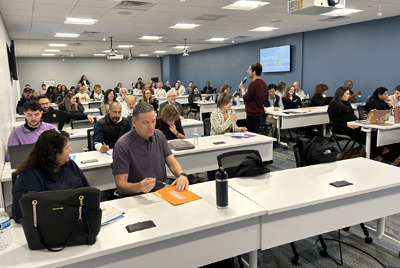
The New Jersey Council for Economic Education (NJCEE) held their annual “Money Talks” event on Oct. 30 at the NJCPA in Roseland, which brought together 80 high school business and personal finance educators in the state. The third gathering held at the NJCPA featured interactive discussions about new ways to explore learning, tools that connect well with students and lessons on how to prepare students for college, first jobs and beyond.
NJCEE Executive Director and Lead Business Educator at Livingston High School Alex Lamon praised what he called the “teacher-to-teacher professional development” that occurred at the event in various content areas. He reminded attendees, “what we teach matters, now more than ever.”
AP Business Challenges
Teachers had candid talks on best practices for entering into a career in business as well as the specific challenges faced when teaching the new advanced placement (AP) Business with Personal Finance course. Since the course tends to have the personal finance section at the end, many high school students who opt for an internship in May of their senior year tend to miss that section entirely though personal finance is on the AP Business Exam.
Reading comprehension is also something that should be considered more earnestly when students sign up for the class, according to Delaney Roberts, a teacher at Livingston High School. “I don’t think they realize how much reading comprehension is in an AP class if this is their first AP class,” she said. “It’s a big portion.”
Classroom to Career
In transitioning from the classroom to the business world, there is often a gap between what organizations want and how prepared students are to make that leap. Don Meyer, CAE, chief growth officer at the NJCPA, moderated a panel on students entering accounting jobs and discussed the importance of not only having communication skills but a basic understanding of office behavior.
Panelist Sarah Krom, CPA, MST, managing partner of SKC & Co. CPAs LLC and past president of the NJCPA, noted that in the process of hiring many young professionals in the post-COVID time period, her team discovered a need for specific non-technical office skills. Krom and her team subsequently established the following behavioral competencies they use at SKC:
- Communication
- Operational effectiveness
- Professionalism
- Judgment and decisiveness
- Teamwork and collaboration
- Critical and strategic thinking
- Client service
“Those are the non-technical things that we actually look for and evaluate our team on,” said Krom. “We did find we had to really define it and explain it, not even just for our new hires but for people that came to us with experience.”
Debbie Lee-Ho, director of campus recruiting at Withum, also sees mastering non-technical skills as a gamechanger for accounting hires, particularly in light of the impact artificial intelligence (AI) is having on the profession. “AI is going to take away a lot of entry-level jobs, so we are trying to upskill new hires,” said Lee-Ho.
Her team is placing a bigger emphasis on communication skills and responding to email invites promptly, for example. “They have to learn how to ask questions, get clarification, get feedback,” she added. Young professionals, she said, underestimate the importance of all of that.
Courtney Napolitano, CPA, MSAC, a senior audit specialist at Merck and an appointed member of the NJCPA Emerging Leaders Council, explained the importance of new hires to be able to “adapt priorities and shifts in the workforce.” They need to be prepared to take different perspectives into account, she added.
To Lee-Ho, the skills that are needed post-graduation can be easily learned from having an afterschool job or participating in a sport. These include showing up on time, practicing good customer service and being actively engaged in an interview.
Though learning can be learning can be different in a hybrid office environment today, Krom noted that shadowing experiences, actually being present on client calls, seeing interactions, creating role playing and practicing breakout sessions all help fill skills gaps from what is being taught in school and needed on the job.
Napolitano also credited participation in various projects and listening to both positive and negative feedback as things that lead to “building that confidence” to successfully transition to the workforce.
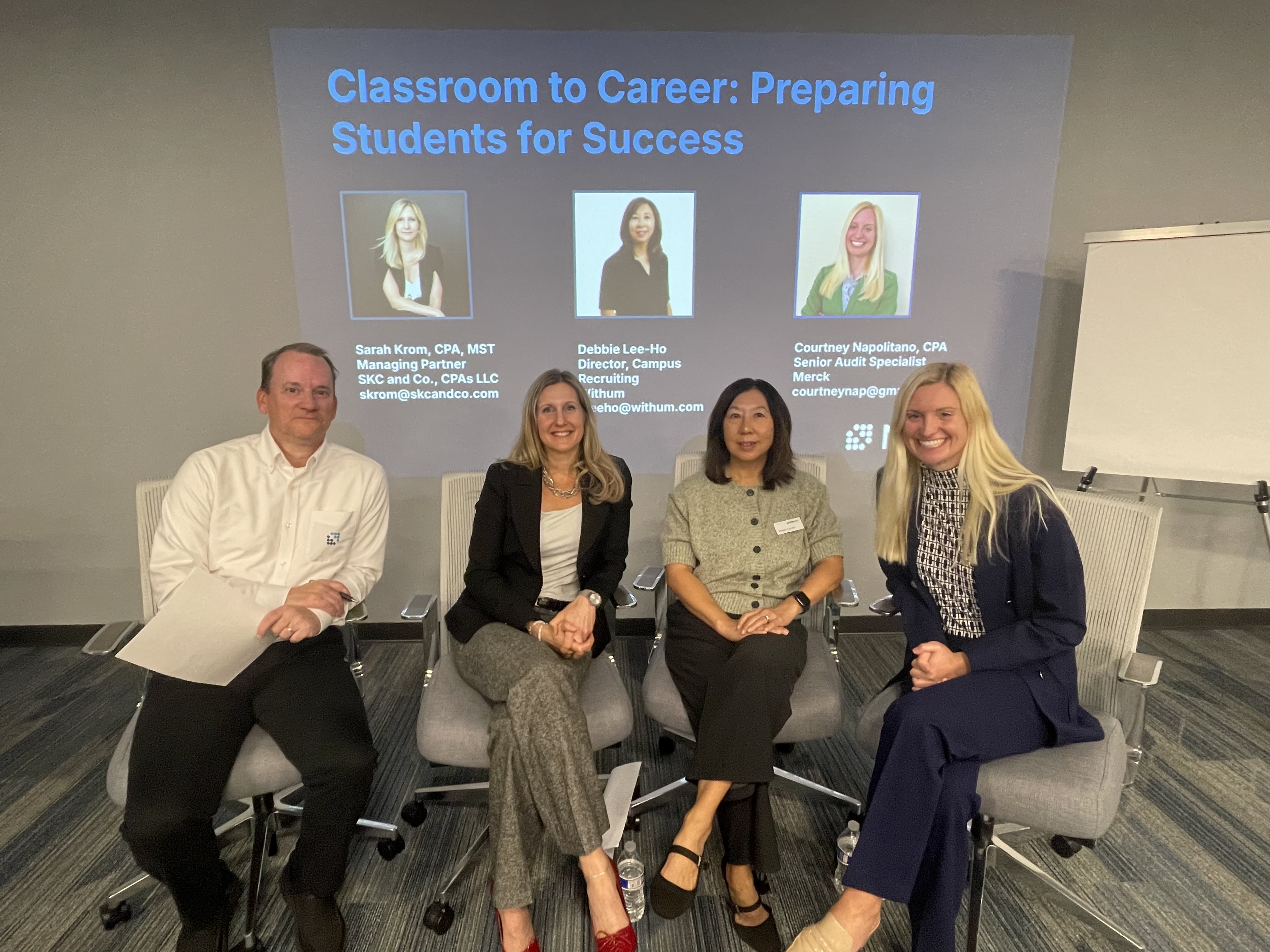
Don Meyer, CAE, chief growth officer at the NJCPA (left); Sarah Krom, CPA, MST, managing partner of SKC & Co. CPAs LLC (center left); Debbie Lee-Ho, director of campus recruiting at Withum (center right); and Courtney Napolitano, CPA, MSAC, a senior audit specialist at Merck (right) discuss career preparation.
Real-World Experience
For students heading directly into the workforce and bypassing college, courses about career readiness not only boost confidence but help to create relationships with business partners, explained Angela Salisbury, business education teacher at Morris Hills High School. She discussed many real-world applications that are currently available to teachers that fall into this category since her students are predominantly entering the workforce directly.
Salisbury, along with other teachers in her school district, is also focused on bringing career readiness to non-business classes. Workplace etiquette and problem-solving are needed in all classes, not just in business classes, she said. “Career readiness is just what we do but that’s not true in biology all the time.”
“There are higher graduation rates when schools incorporate career readiness,” she added, noting career readiness allows for more individual instruction for those students who need extra help. Taking a career-interest inventory is a good first step for students, she said. Useful tools are the following: CareerOneStop, Naviance Career Interest Inventory, O*Net Interest Profiler, BigFuture Career Quiz.